- Section
- Packaging
- Published
- 3 min read
- By Nathan Brooks
Packaging
India's Golden Fibre: Jute Economy Hits Rs 30,000 Crore Scale
India holds 75% of global jute-goods production in a Rs 30,000 crore economy; West Bengal has reopened 17 mills as MSP hits Rs 5,925 per quintal.
At a glance
- India accounts for about 75% of global jute-goods production; the sector is worth roughly Rs 30,000 crore.
- MSP for raw jute rose from Rs 2,400 per quintal in 2014–15 to Rs 5,925 in 2026–27.
- West Bengal reopened 17 jute mills within five months of the new government taking office.
- FY 2025–26 jute-goods exports: 1,71,300 tonnes worth Rs 3,155.27 crore.
- Bihar produced approximately 7.59 lakh bales of jute in 2025–26.
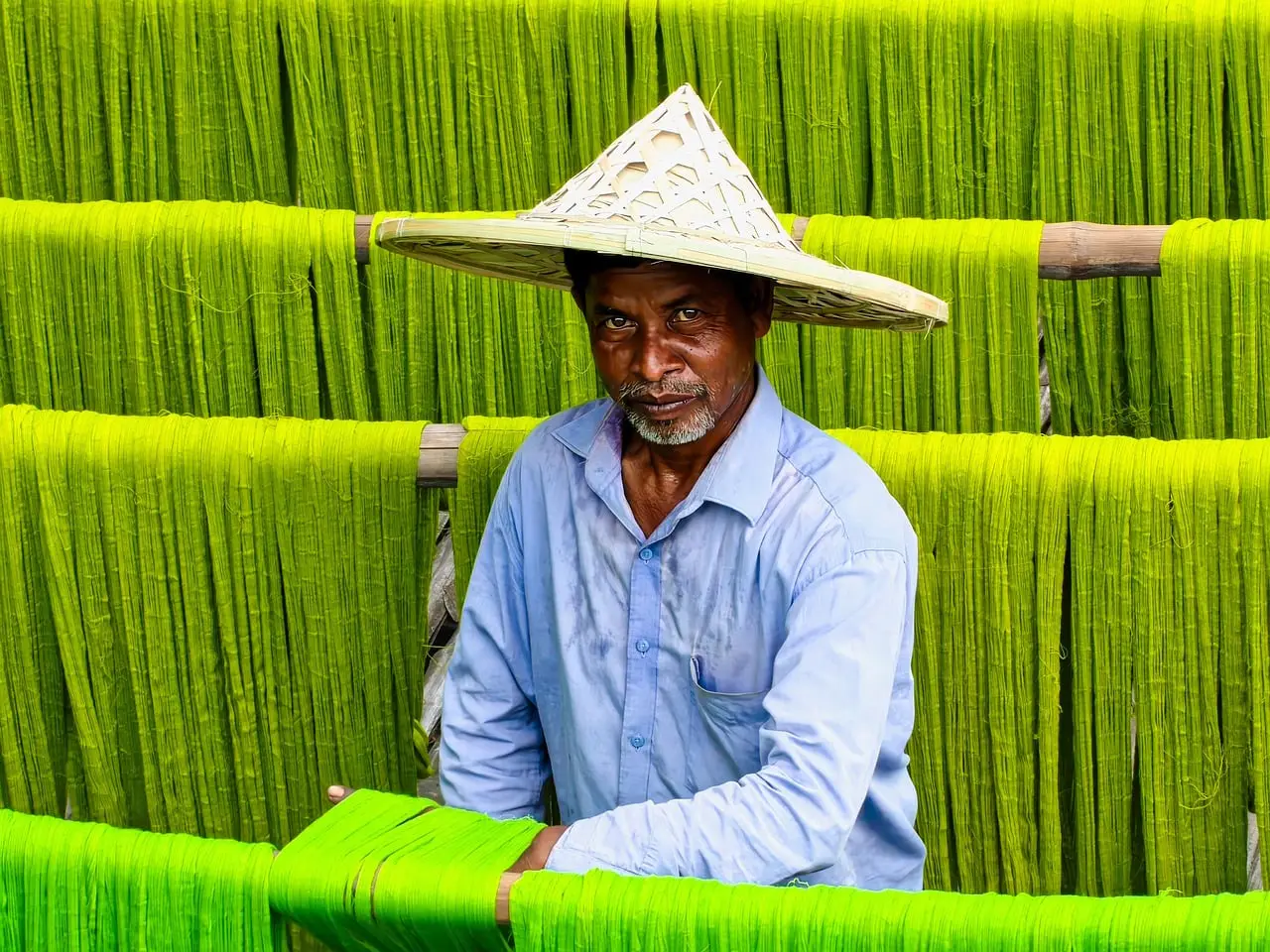
India produces roughly 75% of the world's jute goods, and the sector now represents an economy worth approximately Rs 30,000 crore under the National Fibre Mission 2030–31. The fibre supports nearly 40 lakh farming families and gives direct employment to about 3.70 lakh workers in organised mills and diversified units.
The minimum support price for raw jute tells the story of a decade of policy backing. MSP rose from Rs 2,400 per quintal in 2014–15 to Rs 5,925 for TD-3 grade in 2026–27 — roughly 2.5 times the earlier level. The latest MSP delivers a 61.8% return over the weighted average cost of production, with the Jute Corporation of India continuing price-support operations.
Production numbers back the picture. India produced approximately 76 lakh bales of raw jute in FY 2025–26; the combined jute-and-mesta estimate for the same year stands at 94.03 lakh bales. Jute-goods production reached 12.80 lakh tonnes against domestic consumption of 12.05 lakh tonnes — nearly 94% of production absorbed at home. Rare thing, that. Domestic supply meeting domestic demand is not the usual packaging-industry headline.
What does this change for West Bengal's mills?
West Bengal holds 89 of India's 120 composite jute mills, strung along both banks of the Hooghly River — Budge Budge through Barrackpore to Kalyani on the east, Uluberia through Howrah, Rishra, Serampore, Bhadreswar and Bansberia on the west.
The BJP-led state government made reviving this ecosystem an early priority. Fourteen jute mills resumed operations within 90 days of the party assuming office, through tripartite engagement among the Labour Department, mill managements and workers' representatives. By the five-month mark, the state Labour Minister reported 17 mills reopened.
Where's the export upside?
India exported 1,71,300 tonnes of jute goods worth Rs 3,155.27 crore in FY 2025–26, plus 22,700 tonnes of raw jute valued at Rs 225.11 crore. The market exists. The gap is mix.
Higher-value shopping bags, floor coverings, decorative fabrics, technical textiles and engineered packaging can lift export realisation beyond conventional hessian and sacking. The opportunity, per the source, lies in product innovation, international standards, traceability and stronger connections with global packaging buyers — positioning India as a global supplier of sustainable PackTech and natural-fibre solutions.
New industrial frontiers include:
- Geotextiles for soil stabilisation and erosion control
- Nonwoven fabrics, acoustic and thermal insulation
- Automotive interior components and natural-fibre composites
- Moulded-fibre packaging, protective inserts and industrial cushioning
- Reusable retail bags and premium consumer products
Bihar's role in the raw-material base
After West Bengal, Bihar's north-eastern districts form the next major cultivation belt. Purnea, Katihar, Kishanganj, Araria, Madhepura and adjoining districts hold favourable agro-climatic conditions. Bihar produced approximately 7.59 lakh bales of jute in 2025–26, per the latest state-wise estimate.
Proximity to the West Bengal industrial corridor offers scope for closer raw-material linkages and downstream value addition — scientific retting, fibre grading, improved productivity, storage and stronger procurement networks.
The play ahead is straightforward: combine West Bengal's industrial scale with Bihar's raw-material base, higher MSP, mill revival and machinery modernisation. The source frames the Golden Fibre as a pillar of Atmanirbhar Bharat and biodegradable alternative to fossil-based packaging. For B2B buyers tracking sustainable materials, the supply base is consolidating — and it's mostly in eastern India.
Source: organiser.org
More from Nathan Brooks
Show full bio
Market editor covering companies, deals and strategy in trade marketing, shopper marketing, trade promotions, category management at Target Marketing.
161 articles
Related articles
| November 11, 2026 | CAIT puts 2026 Diwali trade near Rs 7 lakh crore nationwide |
| November 12, 2026 | India's Diwali Trade Set to Cross Rs 7 Lakh Crore in 2026 |
| November 11, 2026 | Bihar’s Makhana cluster scales toward 30,000 MT of exports |
| November 8, 2026 | India's Festive Trade Set to Exceed ₹7 Lakh Crore in 2026 |
| November 11, 2026 | India-Egypt Trade Hits $6.5 Billion as Goyal Leads Delegation to Cairo |